CARPINTERIA VALLEY MUSEUM OF HISTORY
956 Maple Avenue | Carpinteria, California 93013 | 805.684.3112

CIVIL LIBERTIES DOCUMENTARY FILM
SELECTED IMAGES
Through the generous support of the Bates, Fukasawa, Ota, and Satow families, over 1,000 digitized images, created from photographs and negatives, were added to the Museum's photography collection as part of the "Our Faces Will Always Be Japanese": Civil Liberties Stories from Carpinteria project. Images depict a wide range of topics including family and individual portraits, daily life in the Gila River Relocation Center in Arizona and the Rohwer Relocation Center in Arkansas, as well as activities, gatherings, and work pre-, during, and post-World War II. Images added to the Museum's collection also represent Carpinteria, from businesses and ranches to people and events. Selected images on this page represent a small sampling.
"Our Faces Will Always Be Japanese": Civil Liberties Stories from Carpinteria was funded by a California Civil Liberties Program grant through the California State Library.
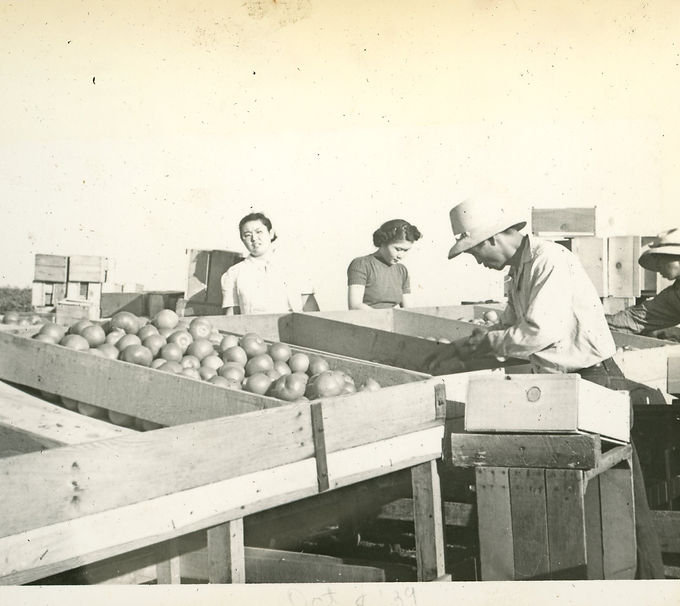
Ota family members packing tomatoes, 1939. In pre-World War II Carpinteria, the Otas were successful farmers, harvesting fruits and vegetables on a large scale.

Miyeko Ota Fukasawa holding John Fukasawa, Jr. near the barracks in the Gila River War Relocation Center in Arizona on July 25, 1943. Over 13,000 Japanese Americans were incarcerated at Gila River between 1942 and 1945.

Satow family image of Rohwer Relocation Center in Arkansas, Block 8.
Over 8,000 Japanese Americans were incarcerated at Rohwer between
1942 and 1945.

Fumio Satow in his Boy Scout uniform in the Rohwer Relocation Center in Arkansas. Scouting continued at all ten of the relocation centers.

Ken Ota and John Fukasawa, Jr. at the Gila River War Relocation Center in Arizona with housing blocks in the background.

Frank Wykoff running with children in 1939. Wykoff won three Olympic medals and was later the principal of Carpinteria's Union Grammar and High School (known as Main School).

Horse-drawn cart in Chicago, Illinois in the mid 1940s. Tom and Kenji Ota worked for the Keeshin Motor Express Company of Chicago as a driver and mechanic, respectively.

The Otas returned to Carpinteria after they were released from the Gila River Relocation Center in Arizona. In June of 1945, Charles E. Mace took a series of photographs for the War Relocation Authority depicting the Ota family as part of its efforts to visually depict resettlement.

United States Post Office at the Gila River Relocation Center in Arizona. The Center was on the Gila River Indian Reservation, fifty miles south of Phoenix. Learn more about the Center through the National Park Service.

At the Gila River Relocation Center in Arizona a monument was built to honor the Japanese Americans who served in the United States military during World War II.

Rincon Causeway between Carpinteria and Ventura. In 1912 it was estimated that this stretch of the Causeway cost $32,000 to construct.

Kijuro, Kenji, and Minoru Ota on their Carpinteria ranch in June of 1945. Photo by Charles E. Mace as part of the War Relocation Authority's resettlement project.